
Connectivity Software User's Guide and Reference
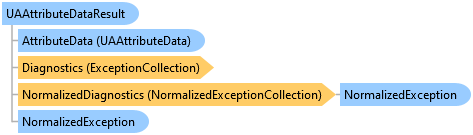
UAAttributeDataResult Class
'Declaration<CLSCompliantAttribute(True)> <ComDefaultInterfaceAttribute(OpcLabs.EasyOpc.UA.OperationModel.ComTypes._UAAttributeDataResult)> <ComVisibleAttribute(True)> <GuidAttribute("111C8C94-4928-4A45-8127-CC73667A2428")> <TypeConverterAttribute(System.ComponentModel.ExpandableObjectConverter)> <ValueControlAttribute("OpcLabs.BaseLib.Forms.Common.ObjectSerializationControl, OpcLabs.BaseLibForms, Version=5.84.192.1, Culture=neutral, PublicKeyToken=6faddca41dacb409", DefaultReadWrite=False, Export=True, PageId=10001)> <SerializableAttribute()> Public Class UAAttributeDataResult Inherits OpcLabs.BaseLib.OperationModel.OperationResult Implements LINQPad.ICustomMemberProvider, OpcLabs.BaseLib.ComTypes._Info, OpcLabs.BaseLib.ComTypes._Object2, OpcLabs.BaseLib.OperationModel.ComTypes._OperationResult, OpcLabs.EasyOpc.UA.OperationModel.ComTypes._UAAttributeDataResult, System.ICloneable, System.IFormattable, System.Runtime.Serialization.ISerializable, System.Xml.Serialization.IXmlSerializable
'UsageDim instance As UAAttributeDataResult
[CLSCompliant(true)]
[ComDefaultInterface(OpcLabs.EasyOpc.UA.OperationModel.ComTypes._UAAttributeDataResult)]
[ComVisible(true)]
[Guid("111C8C94-4928-4A45-8127-CC73667A2428")]
[TypeConverter(System.ComponentModel.ExpandableObjectConverter)]
[ValueControl("OpcLabs.BaseLib.Forms.Common.ObjectSerializationControl, OpcLabs.BaseLibForms, Version=5.84.192.1, Culture=neutral, PublicKeyToken=6faddca41dacb409",
   DefaultReadWrite=false,
   Export=true,
   PageId=10001)]
[Serializable()]
public class UAAttributeDataResult : OpcLabs.BaseLib.OperationModel.OperationResult, LINQPad.ICustomMemberProvider, OpcLabs.BaseLib.ComTypes._Info, OpcLabs.BaseLib.ComTypes._Object2, OpcLabs.BaseLib.OperationModel.ComTypes._OperationResult, OpcLabs.EasyOpc.UA.OperationModel.ComTypes._UAAttributeDataResult, System.ICloneable, System.IFormattable, System.Runtime.Serialization.ISerializable, System.Xml.Serialization.IXmlSerializable
[CLSCompliant(true)]
[ComDefaultInterface(OpcLabs.EasyOpc.UA.OperationModel.ComTypes._UAAttributeDataResult)]
[ComVisible(true)]
[Guid("111C8C94-4928-4A45-8127-CC73667A2428")]
[TypeConverter(System.ComponentModel.ExpandableObjectConverter)]
[ValueControl("OpcLabs.BaseLib.Forms.Common.ObjectSerializationControl, OpcLabs.BaseLibForms, Version=5.84.192.1, Culture=neutral, PublicKeyToken=6faddca41dacb409",
   DefaultReadWrite=false,
   Export=true,
   PageId=10001)]
[Serializable()]
public ref class UAAttributeDataResult : public OpcLabs.BaseLib.OperationModel.OperationResult, LINQPad.ICustomMemberProvider, OpcLabs.BaseLib.ComTypes._Info, OpcLabs.BaseLib.ComTypes._Object2, OpcLabs.BaseLib.OperationModel.ComTypes._OperationResult, OpcLabs.EasyOpc.UA.OperationModel.ComTypes._UAAttributeDataResult, System.ICloneable, System.IFormattable, System.Runtime.Serialization.ISerializable, System.Xml.Serialization.IXmlSerializable
The result is successful if the OpcLabs.BaseLib.OperationModel.OperationResult.Exception is a null reference. Otherwise, this property contains information about the reason of the failure.
// This example shows how to read data (value, timestamps, and status code) of 3 attributes at once. In this example,
// we are reading a Value attribute of 3 different nodes, but the method can also be used to read multiple attributes
// of the same node.
//
// Find all latest examples here: https://www.doc-that.com/files/onlinedocs/OPCLabs-ConnectivityStudio/Latest/examples.html .
// OPC client and subscriber examples in C# on GitHub: https://github.com/OPCLabs/Examples-ConnectivityStudio-CSharp .
// Missing some example? Ask us for it on our Online Forums, https://forum.opclabs.com/forum/index ! You do not have to own
// a commercial license in order to use Online Forums, and we reply to every post.

using System;
using OpcLabs.EasyOpc.UA;
using OpcLabs.EasyOpc.UA.OperationModel;

namespace UADocExamples._EasyUAClient
{
    partial class ReadMultiple
    {
        public static void Main1()
        {
            UAEndpointDescriptor endpointDescriptor =
                "opc.tcp://opcua.demo-this.com:51210/UA/SampleServer";
            // or "http://opcua.demo-this.com:51211/UA/SampleServer" (currently not supported)
            // or "https://opcua.demo-this.com:51212/UA/SampleServer/"

            // Instantiate the client object.
            var client = new EasyUAClient();

            // Obtain attribute data. By default, the Value attributes of the nodes will be read.
            UAAttributeDataResult[] attributeDataResultArray = client.ReadMultiple(new[]
                {
                    new UAReadArguments(endpointDescriptor, "nsu=http://test.org/UA/Data/ ;i=10845"),
                    new UAReadArguments(endpointDescriptor, "nsu=http://test.org/UA/Data/ ;i=10853"),
                    new UAReadArguments(endpointDescriptor, "nsu=http://test.org/UA/Data/ ;i=10855")
                });

            // Display results.
            foreach (UAAttributeDataResult attributeDataResult in attributeDataResultArray)
            {
                if (attributeDataResult.Succeeded)
                    Console.WriteLine($"AttributeData: {attributeDataResult.AttributeData}");
                else
                    Console.WriteLine($"*** Failure: {attributeDataResult.ErrorMessageBrief}");
            }
        }

        // Example output:
        //
        //AttributeData: 51 {Int16} @11/6/2011 1:49:19 PM @11/6/2011 1:49:19 PM; Good
        //AttributeData: -1993984 {Single} @11/6/2011 1:49:19 PM @11/6/2011 1:49:19 PM; Good
        //AttributeData: Yellow% Dragon Cat) White Blue Dog# Green Banana- {String} @11/6/2011 1:49:19 PM @11/6/2011 1:49:19 PM; Good
    }
}
# This example shows how to read data (value, timestamps, and status code) of 3 attributes at once. In this example,
# we are reading a Value attribute of 3 different nodes, but the method can also be used to read multiple attributes
# of the same node.
#
# Find all latest examples here: https://www.doc-that.com/files/onlinedocs/OPCLabs-ConnectivityStudio/Latest/examples.html .
# OPC client and subscriber examples in PowerShell on GitHub: https://github.com/OPCLabs/Examples-ConnectivityStudio-PowerShell .
# Missing some example? Ask us for it on our Online Forums, https://forum.opclabs.com/forum/index ! You do not have to own
# a commercial license in order to use Online Forums, and we reply to every post.

#requires -Version 5.1
using namespace OpcLabs.EasyOpc.UA
using namespace OpcLabs.EasyOpc.UA.OperationModel

# The path below assumes that the current directory is [ProductDir]/Examples-NET/PowerShell/Windows .
Add-Type -Path "../../../Components/Opclabs.QuickOpc/net472/OpcLabs.EasyOpcUAPrimitives.dll"
Add-Type -Path "../../../Components/Opclabs.QuickOpc/net472/OpcLabs.EasyOpcUACore.dll"
Add-Type -Path "../../../Components/Opclabs.QuickOpc/net472/OpcLabs.EasyOpcUA.dll"
Add-Type -Path "../../../Components/Opclabs.QuickOpc/net472/OpcLabs.EasyOpcUAComponents.dll"

[UAEndpointDescriptor]$endpointDescriptor =
    "opc.tcp://opcua.demo-this.com:51210/UA/SampleServer"
# or "http://opcua.demo-this.com:51211/UA/SampleServer" (currently not supported)
# or "https://opcua.demo-this.com:51212/UA/SampleServer/"

# Instantiate the client object.
$client = New-Object EasyUAClient

# Obtain attribute data. By default, the Value attributes of the nodes will be read.
$attributeDataResultArray = $client.ReadMultiple(@(
        (New-Object UAReadArguments($endpointDescriptor, "nsu=http://test.org/UA/Data/ ;i=10845")),
        (New-Object UAReadArguments($endpointDescriptor, "nsu=http://test.org/UA/Data/ ;i=10853")),
        (New-Object UAReadArguments($endpointDescriptor, "nsu=http://test.org/UA/Data/ ;i=10855"))
    ))

foreach ($attributeDataResult in $attributeDataResultArray) {
    if ($attributeDataResult.Succeeded) {
        Write-Host "AttributeData: $($attributeDataResult.AttributeData)"
    }
    else {
        Write-Host "*** Failure: $($attributeDataResult.ErrorMessageBrief)"
    }
}


# Example output:
#
#AttributeData: 51 {Int16} @11/6/2011 1:49:19 PM @11/6/2011 1:49:19 PM; Good
#AttributeData: -1993984 {Single} @11/6/2011 1:49:19 PM @11/6/2011 1:49:19 PM; Good
#AttributeData: Yellow% Dragon Cat) White Blue Dog# Green Banana- {String} @11/6/2011 1:49:19 PM @11/6/2011 1:49:19 PM; Good
' This example shows how to read data (value, timestamps, and status code) of 3 attributes at once. In this example,
' we are reading a Value attribute of 3 different nodes, but the method can also be used to read multiple attributes
' of the same node.
'
' Find all latest examples here: https://www.doc-that.com/files/onlinedocs/OPCLabs-ConnectivityStudio/Latest/examples.html .
' OPC client and subscriber examples in VB.NET on GitHub: https://github.com/OPCLabs/Examples-ConnectivityStudio-VBNET .
' Missing some example? Ask us for it on our Online Forums, https://forum.opclabs.com/forum/index ! You do not have to own
' a commercial license in order to use Online Forums, and we reply to every post.

Imports OpcLabs.EasyOpc.UA
Imports OpcLabs.EasyOpc.UA.OperationModel

Namespace Global.UADocExamples._EasyUAClient
    Partial Friend Class ReadMultiple
        Public Shared Sub Main1()

            ' Define which server we will work with.
            Dim endpointDescriptor As UAEndpointDescriptor =
                    "opc.tcp://opcua.demo-this.com:51210/UA/SampleServer"
            ' or "http://opcua.demo-this.com:51211/UA/SampleServer" (currently not supported)
            ' or "https://opcua.demo-this.com:51212/UA/SampleServer/"

            ' Instantiate the client object
            Dim client = New EasyUAClient()

            ' Obtain attribute data. By default, the Value attributes of the nodes will be read.
            Dim attributeDataResultArray() As UAAttributeDataResult = client.ReadMultiple(New UAReadArguments() _
               {
                   New UAReadArguments(endpointDescriptor, "nsu=http://test.org/UA/Data/ ;i=10845"),
                   New UAReadArguments(endpointDescriptor, "nsu=http://test.org/UA/Data/ ;i=10853"),
                   New UAReadArguments(endpointDescriptor, "nsu=http://test.org/UA/Data/ ;i=10855")
               })

            ' Display results
            For Each attributeDataResult As UAAttributeDataResult In attributeDataResultArray
                If attributeDataResult.Succeeded Then
                    Console.WriteLine("AttributeData: {0}", attributeDataResult.AttributeData)
                Else
                    Console.WriteLine("*** Failure: {0}", attributeDataResult.ErrorMessageBrief)
                End If
            Next attributeDataResult

            ' Example output:
            '
            'AttributeData: 51 {System.Int16} @11/6/2011 1:49:19 PM @11/6/2011 1:49:19 PM; Good
            'AttributeData: -1993984 {System.Single} @11/6/2011 1:49:19 PM @11/6/2011 1:49:19 PM; Good
            'AttributeData: Yellow% Dragon Cat) White Blue Dog# Green Banana- {System.String} @11/6/2011 1:49:19 PM @11/6/2011 1:49:19 PM; Good
        End Sub
    End Class
End Namespace
# This example shows how to read data (value, timestamps, and status code) of 3 attributes at once. In this example,
# we are reading a Value attribute of 3 different nodes, but the method can also be used to read multiple attributes
# of the same node.
#
# Find all latest examples here: https://www.doc-that.com/files/onlinedocs/OPCLabs-ConnectivityStudio/Latest/examples.html .
# OPC client and subscriber examples in Python on GitHub: https://github.com/OPCLabs/Examples-ConnectivityStudio-Python .
# Missing some example? Ask us for it on our Online Forums, https://forum.opclabs.com/forum/index ! You do not have to own
# a commercial license in order to use Online Forums, and we reply to every post.
# The QuickOPC package is needed. Install it using "pip install opclabs_quickopc".
import opclabs_quickopc
import time

# Import .NET namespaces.
from OpcLabs.EasyOpc.UA import *
from OpcLabs.EasyOpc.UA.OperationModel import *


endpointDescriptor = UAEndpointDescriptor('opc.tcp://opcua.demo-this.com:51210/UA/SampleServer')
# or 'http://opcua.demo-this.com:51211/UA/SampleServer' (currently not supported)
# or 'https://opcua.demo-this.com:51212/UA/SampleServer/'

# Instantiate the client object.
client = EasyUAClient()

# Obtain attribute data. By default, the Value attributes of the nodes will be read.
attributeDataResultArray = client.ReadMultiple([
    UAReadArguments(endpointDescriptor, UANodeDescriptor('nsu=http://test.org/UA/Data/ ;i=10845')),
    UAReadArguments(endpointDescriptor, UANodeDescriptor('nsu=http://test.org/UA/Data/ ;i=10853')),
    UAReadArguments(endpointDescriptor, UANodeDescriptor('nsu=http://test.org/UA/Data/ ;i=10855')),
    ])

# Display results.
for attributeDataResult in attributeDataResultArray:
    if attributeDataResult.Succeeded:
        print('AttributeData: ', attributeDataResult.AttributeData, sep='')
    else:
        print('*** Failure: ', attributeDataResult.ErrorMessageBrief, sep='')

print()
print('Finished.')
// This KEPServerEX/UA example shows how to read data (value, timestamps, and status code) of 3 attributes at once. In this
// example, we are reading a Value attribute of 3 different nodes, but the method can also be used to read multiple
// attributes of the same node.
//
// Find all latest examples here: https://www.doc-that.com/files/onlinedocs/OPCLabs-ConnectivityStudio/Latest/examples.html .
// OPC client and subscriber examples in C# on GitHub: https://github.com/OPCLabs/Examples-ConnectivityStudio-CSharp .
// Missing some example? Ask us for it on our Online Forums, https://forum.opclabs.com/forum/index ! You do not have to own
// a commercial license in order to use Online Forums, and we reply to every post.

using System;
using OpcLabs.EasyOpc.UA;
using OpcLabs.EasyOpc.UA.AddressSpace;
using OpcLabs.EasyOpc.UA.OperationModel;

namespace UADocExamples.Specialized
{
    partial class Kepware_KEPServerEX_UA
    {
        public static void ReadMultiple()
        {
            UAEndpointDescriptor endpointDescriptor = "opc.tcp://localhost:49320";  // default KEPServerEX/UA endpoint

            // Instantiate the client object.
            var client = new EasyUAClient();

            // Obtain attribute data. By default, the Value attributes of the nodes will be read.
            UAAttributeDataResult[] attributeDataResultArray = client.ReadMultiple(new[]
                {
                    // The UANodeId.KEPServerEX(...) helper method simplifies creation of node IDs for KEPServerEX/UA nodes.
                    new UAReadArguments(endpointDescriptor, UANodeId.KEPServerEX("Simulation Examples.Functions.Random1")),
                    new UAReadArguments(endpointDescriptor, UANodeId.KEPServerEX("Simulation Examples.Functions.Ramp1")),
                    new UAReadArguments(endpointDescriptor, UANodeId.KEPServerEX("Simulation Examples.Functions.Sine1")),
                    new UAReadArguments(endpointDescriptor, UANodeId.KEPServerEX("Simulation Examples.Functions.User1"))
                });

            // Display results.
            foreach (UAAttributeDataResult attributeDataResult in attributeDataResultArray)
            {
                if (attributeDataResult.Succeeded)
                    Console.WriteLine($"AttributeData: {attributeDataResult.AttributeData}");
                else
                    Console.WriteLine($"*** Failure: {attributeDataResult.ErrorMessageBrief}");
            }
        }
    }
}
System.Object
OpcLabs.BaseLib.Object2
OpcLabs.BaseLib.Info
OpcLabs.BaseLib.OperationModel.OperationResult
OpcLabs.EasyOpc.UA.OperationModel.UAAttributeDataResult
OpcLabs.EasyOpc.UA.Generic.UAAttributeDataResult<T>